I don’t know if this happens to you too, but sometimes flowers behave like people at a dinner party. Some stay quiet and elegant in the corner. Some absolutely need to be noticed. Some stretch across the entire table like they own the place.
That was this week. I basically hosted a floral dinner party.
One arrangement became soft and spacious, full of winding branches and quiet movement. The other turned into a lively little conversation between roses, twisting lines, and one bright pink accent that honestly refused to behave subtly.
Here’s what grew out of this week’s conversations.
Drawn in Space
Contemporary Freestyle Ikebana (Jiyūka) inspired by the expressive movement and sculptural freedom of the Sōgetsu school.
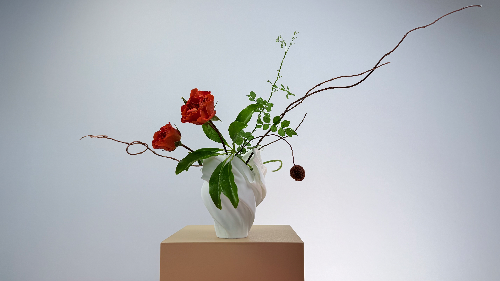
This arrangement began with the branches. They immediately felt like movement to me. Not fast movement, but more like a thought slowly drifting across a room.
The long sweeping branch became the Shin, creating the main movement of the arrangement. The softer greenery and supporting line became the Soe, while the rust-colored roses settled into the Hikae, bringing warmth and grounding everything closer to the vessel.
I loved the way the long lines stretched while the roses stayed close to the center, adding warmth without interrupting the quiet feeling of the piece. The little hanging seed pod felt like a tiny pause suspended in midair.
The white vessel also softened everything. It almost feels windblown to me.
What I love most here is the breathing room. Nothing crowded. Nothing forced. Just space, movement, and a little stillness.
The One that Refused to be Quiet
A contemporary Sōgetsu-style Jiyūka arrangement built upon an abstracted Shin–Soe–Hikae structure.
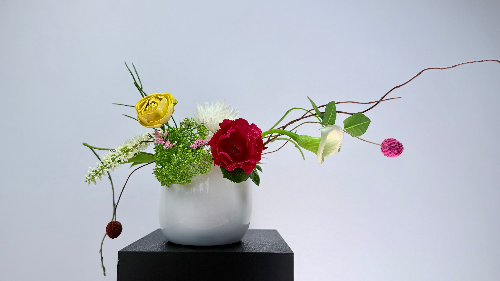
This arrangement had completely different energy. The dramatic branch extending outward becomes the Shin, establishing the main directional line of the composition.
The calla lily and supporting branch movement create the Soe, adding rhythm and conversation around the main line. Lower in the arrangement, the red rose and yellow bloom act as the Hikae, bringing warmth, personality, and a grounded human feeling to the piece.
The red rose wanted drama immediately. The yellow bloom clearly wanted equal attention. The calla lily leaned sideways like it had somewhere else to be. And that bright pink sphere at the edge? Honestly, it feels like the friend in the group chat who always says the unexpected thing out loud.
I kept laughing while arranging this one because every material seemed determined to have its own personality. Honestly, I just tried to keep everyone getting along.
That balance between movement, tension, and breathing room is one of the things I love most about Jiyūka style.
Quick Ikebana Tip
Did You Know? Jiyūka means “free style” in Ikebana.
It gives us more freedom with movement, shape, and materials. Branches can wander. Flowers do not need to sit politely in the center. Empty space becomes part of the design too.
Even in free style arrangements, balance and harmony are still quietly doing their job in the background.