Purple walked into my studio twice this week and created the most beautiful invisible line between two completely different arrangements. One wild, one whisper quiet.
In Sogetsu Ikebana, that's called intention. I call it a very good week. Come see what I mean!
The Question Mark in a Green Vase
Beautiful, a little mysterious, and very much in charge of its own silence.
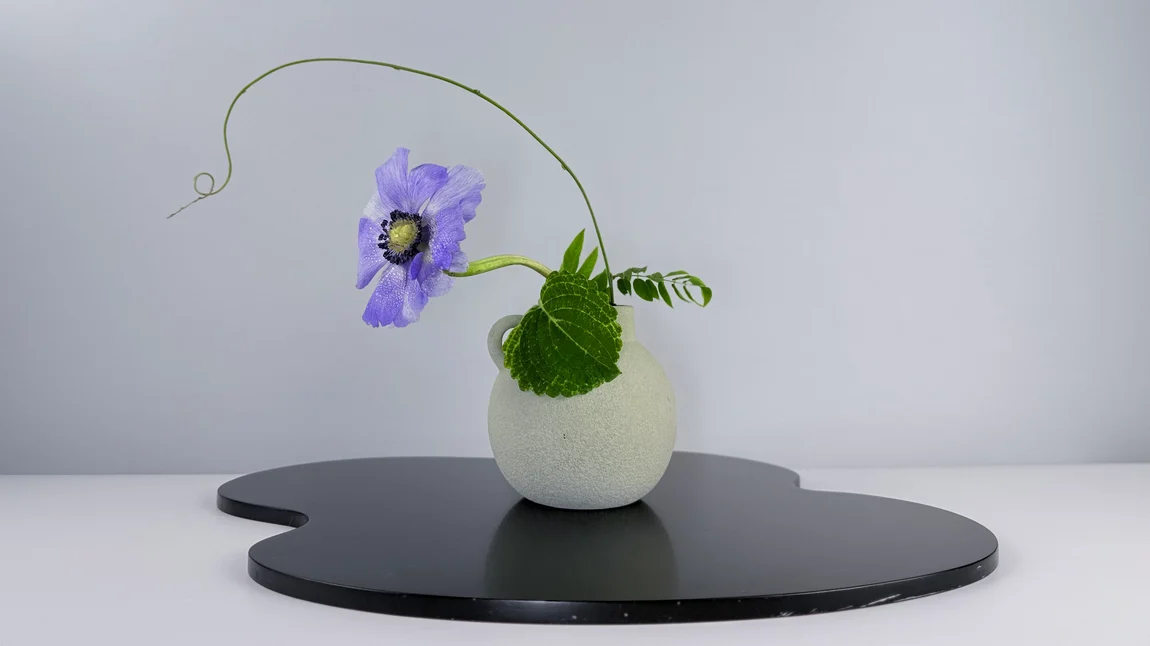
This one started with the vine. It went up, curved left, curled at the very end like it was asking something, and then just stayed there. I looked at it for a while. I didn't have an answer.
So I added the anemone, one single blue-purple bloom, open and unapologetic, and a few green leaves to keep everyone grounded. That was it. Nothing more was needed.
In Sogetsu Ikebana, restraint is just as powerful as abundance. Three elements, one question mark, and a purple flower that somehow fills the entire room.
This arrangement feels like a quiet Sunday morning. Beautiful, a little mysterious, and very much in charge of its own silence.
Wild, Twisted, and Absolutely Intentional
Everything slightly untamed, completely alive, and absolutely purple.
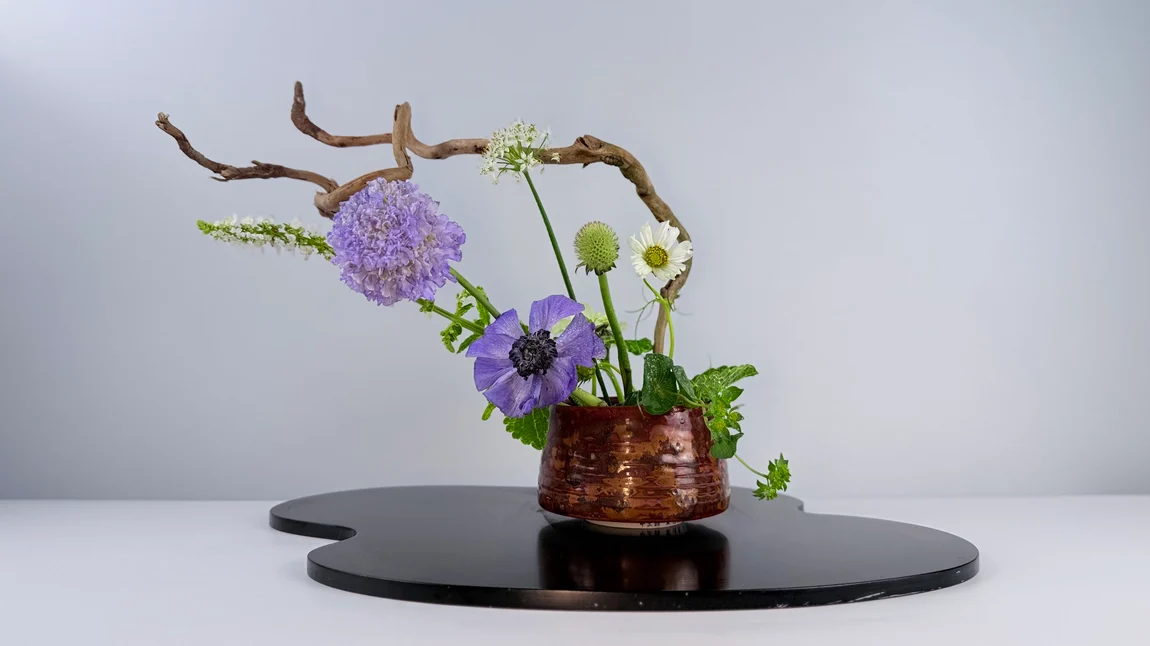
I picked up the driftwood branch first. Big mistake. The moment it was in my hands it started making decisions; sweeping right, twisting three times, going places nobody planned.
So I put it down, stepped back, and said fine. You're in charge.
The purple bloom came next, because apparently the branch needed an audience. Then the blue anemone walked in and immediately became the most dramatic thing in the room, which is impressive considering the branch.
The white blooms, the green globes, the daisy - they all found their spots and settled in like they'd been there all along.
In Sogetsu Ikebana, you work with what the material wants to do, not against it. This branch wanted to perform. I just held the kenzan and stayed out of the way.
When I stepped back, I felt like I was standing at the edge of a wild garden after a very good storm; everything slightly untamed, completely alive, and absolutely purple.
Quick Ikebana Tip
Color Is a Line. Did you know that in Sogetsu Ikebana, color is considered a line? Sofu Teshigahara believed that repeating a color across an arrangement creates an invisible connection, like a thread that ties everything together without a single stem.
That's why when the same purple appears in a wild, full arrangement and a minimal three-element piece, they still feel like they belong to the same conversation.
Next time you arrange, try repeating one color in two different elements and watch what happens. The arrangement will do the rest.